
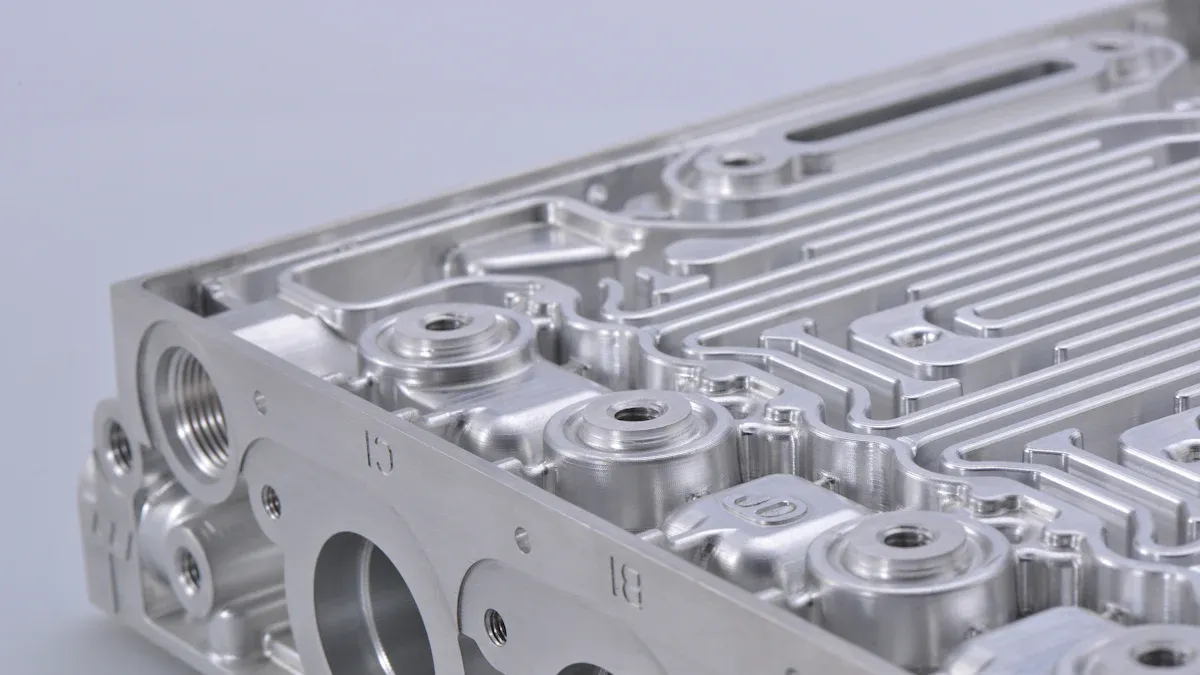
An engineer’s journey to select the right component involves a careful evaluation, especially when it comes to precision powdered metal parts. You must weigh your application’s needs against four key pillars: Part Complexity, Performance Demands, Production Volume, and Cost. This process helps you find the perfect balance, ensuring your chosen parts meet design, performance, and budget goals for any project.
The market for powdered metal parts is growing quickly, a trend that shows the increasing trust in these components for various applications.
| Metric | Value |
|---|---|
| 2024 Market Size | USD 6.92 billion |
| 2030 Projected Market Size | USD 10.18 billion |
| CAGR (2025-2030) | 5.8% |
This expansion highlights the importance of making informed decisions. Your choice impacts the final product’s success, affecting everything from production efficiency to overall performance.
Process Selection by Part Design
Your part’s shape is a major factor in choosing a manufacturing process. Different powder pressing techniques handle geometric complexity in very different ways. You must evaluate your design’s features to find the most efficient production path for your parts.
Matching Complexity and Geometry
Conventional powder metallurgy, which uses high-pressure uniaxial pressing, works best for simpler shapes. This method allows for easy ejection of parts from the mold. However, the nature of this pressing process creates limitations. You cannot use it to form features like:
- Cross-holes or blind holes
- Undercuts
- Threads
- Reverse tapers
If your design requires these features, you must add them through secondary machining after the parts are sintered. For more intricate parts, Metal Injection Molding (MIM) offers greater freedom. This process is excellent for combining multiple components into a single, integrated piece. This consolidation reduces assembly needs and improves the reliability of the final parts.
| Feature/Process | Metal Injection Molding (MIM) | Conventional Press-and-Sinter (PM) |
|---|---|---|
| Shape Complexity | High 3D design freedom for intricate shapes. | Best for simple shapes that allow for easy ejection. |
| Specific Features | Can create undercuts, threads, and knurling. | Cannot produce undercuts, threads, or cross-holes. |
| Part Consolidation | Excellent for combining multiple parts into one. | Requires separate parts for complex assemblies. |
Pro Tip: When designing for MIM, aim for uniform wall thickness to prevent distortion during sintering. You should also use rounded corners instead of sharp ones, as sharp internal corners can create voids during the injection pressing.
Achieving Dimensional Accuracy
Achieving tight tolerances is critical for many engineering applications. The powder pressing techniques you choose directly impact the final dimensional accuracy and tolerances of your powdered metal parts.
Conventional cold pressing produces parts with good accuracy, typically ranging from IT8 to IT9. You can improve this to IT6–IT7 with a secondary sizing operation. For small parts, this pressing method can achieve tolerances as tight as ±5 μm. In contrast, MIM delivers excellent accuracy, making it ideal for small, complex parts that demand very tight tolerances.
The sintering stage is crucial for final accuracy. During this heating process, the metal particles bond and the part densifies, causing it to shrink. This shrinkage, often between 15% and 20% for MIM parts, must be carefully controlled. Non-uniform shrinkage can cause warpage, so managing the sintering process is key to meeting your design’s specifications for accuracy and tolerances.
Aligning Performance with Application Needs
You must align the material’s properties with your application’s demands to ensure optimal performance. The powder pressing process directly influences the final density, porosity, and strength of your parts. Understanding this relationship helps you specify the right characteristics for your high-performance components.
Density, Porosity, and Strength
The density of powdered metal parts is a critical factor for performance. Higher density, achieved through higher pressure during the pressing stage, generally improves the mechanical strength and hardness of the final part. For example, studies on pressed-and-sintered PM steel show a direct link between increased density and higher ultimate tensile strength. This improved performance is crucial for load-bearing parts.
However, porosity isn’t always a drawback. You can use controlled porosity to your advantage in certain applications. The network of pores created during sintering is ideal for:
- Self-Lubrication: Engineered pores in parts like bronze bearings and bushings hold lubricants. This feature provides quiet, continuous self-lubrication, which is highly valued in the automotive industry.
- Filtration: The interconnected pores in sintered metal components, often made from iron powder, create effective filters. You can use these parts to precisely separate gases and liquids in industrial systems.
Your control over the pressing process allows you to tailor the density and porosity, directly impacting the part’s final performance and function. Effective quality control during pressing ensures consistent results.
Surface Finish and Secondary Operations
The initial pressing and sintering steps determine the base surface finish and properties of your parts. For many applications, you will need secondary operations to meet specific performance requirements. These post-sintering processes enhance the quality and capabilities of your powdered metal parts.
These operations can improve everything from dimensional accuracy to wear resistance. Choosing the right secondary operations is key to optimizing the performance of your parts. For instance, heat treating can significantly boost mechanical strength and hardness. Plating can provide corrosion resistance without needing more expensive base materials. Each pressing operation offers a path to a specific performance outcome.
| Secondary Operation | Common Objective |
|---|---|
| Sizing/Coining | Improves dimensional accuracy and increases density after pressing. |
| Heat Treating | Increases hardness and enhances wear resistance for demanding parts. |
| Impregnation | Seals porosity for pressure tightness or self-lubrication. |
| Plating/Coating | Improves corrosion resistance and enhances aesthetic appeal. |
These finishing steps are essential for transforming a standard part from the pressing process into a component ready for a high-performance application.
Key Material Considerations for Powdered Metal Parts

Your choice of materials is a critical step in designing powdered metal parts. The right material ensures your component has the required strength, corrosion resistance, and thermal stability. Proper material selection and compatibility with the pressing process will define the final performance of your parts.
Ferrous and Non-Ferrous Alloys
You will find that ferrous materials, like iron and steel alloys, are the most common choice for powder pressing. These materials offer excellent mechanical strength and are cost-effective for a wide range of applications. The pressing process for these materials is well-established.
Non-ferrous materials provide unique properties for specialized needs. Aluminum and bronze are popular choices when you require different characteristics. The pressing of these materials is tailored to their specific behaviors.
- Aluminum: You can use aluminum powders for vehicle components, electronics, and even solar panel parts. Its lightweight nature is a significant advantage.
- Bronze: You should choose bronze for parts needing high density and strength, such as self-lubricating bearings and bushings. The pressing of bronze powders creates a porous structure ideal for holding lubricants.
These versatile materials allow you to design components for many industries, from automotive to marine hardware.
Superalloys and Specialty Materials
When your application involves extreme temperatures or harsh environments, you need to consider superalloys. These materials maintain their strength and corrosion resistance at very high temperatures. Many superalloys are available in powder form for pressing, including:
| Inconel Superalloys | Hastelloy Superalloys |
|---|---|
| Inconel 718 | Hastelloy B |
| Inconel 625 | Hastelloy C-276 |
| Inconel 738 | Hastelloy X |
For example, Hastelloy X powder offers excellent oxidation resistance, making it perfect for gas turbine combustion zone components. The pressing of these advanced materials requires precise control.
Specialty materials like titanium and tungsten carbide open doors for cutting-edge applications. Titanium’s high strength-to-weight ratio and biocompatibility make it a top choice for aerospace frames and medical implants. Tungsten carbide is known for its exceptional hardness, close to that of a diamond, making it ideal for cutting tools. The pressing of these unique materials enables the creation of components with unparalleled performance.
The Economics of Powdered Metal Manufacturing
You must evaluate the financial impact of your component choices. The economics of powdered metal manufacturing offer a compelling case for many projects. Understanding the cost structure helps you make a smart investment. The metal powder pressing process provides unique financial benefits, especially when you scale up production.
Comparing the Metal Powder Pressing Process
The metal powder pressing process is known for its outstanding efficiency. One of the key advantages of powdered metal manufacturing is its minimal material waste. The metal powder pressing process utilizes up to 97% of the raw materials. This is a sharp contrast to traditional machining, which can generate significant scrap. This efficient use of materials directly lowers your costs.
Powdered metal manufacturing also excels at creating complex geometries in a single step. A design with features like internal oil passages would require five or more separate operations with machining. The metal powder pressing process, however, produces a complete component in one pressing operation. This consolidation reduces manufacturing time and labor, making the metal powder pressing process highly economical. This single-step pressing is a major benefit of the metal powder pressing process.
Tooling Investment vs. Per-Part Cost
You need to balance the initial tooling investment against the final cost per part. Powdered metal manufacturing requires an upfront investment in custom tooling for the pressing stage. While this initial cost is higher than for some other methods, it unlocks significant savings as production volume increases. The cost-effectiveness of the metal powder pressing process shines in medium to high-volume runs.
Consider the cost of custom gears. Machining an aluminum gear might cost you $45 to $65 per unit, while a steel one could be $80 to $120. With powdered metal manufacturing, the initial tooling cost is recouped quickly through a much lower per-part price at high volumes.
Key Takeaway: The high initial tooling cost for the pressing die is offset by the low per-part cost in large production runs. This makes powdered metal manufacturing an ideal choice for projects where you need high-quality parts at scale. Your choice of materials and the complexity of the pressing will influence the final cost.
Making the Final Decision for Precision Powdered Metal Parts
You have now explored the core pillars of powdered metal manufacturing. Making the final decision requires you to synthesize this knowledge. You must weigh the trade-offs between production volume, design complexity, and total cost to select the optimal path for your project. This final step ensures your choice aligns perfectly with your application’s unique demands.
High-Volume vs. High-Complexity
Your production needs will heavily influence your choice between a process optimized for volume and one designed for complexity. Each path offers distinct economic and performance advantages.
For high-volume production, conventional powder metallurgy stands out for its efficiency and cost-effectiveness. The process is inherently additive, meaning it builds the part to its near-net shape. This approach minimizes waste and maximizes material utilization.
| Factor | Powder Metallurgy | CNC Machining |
|---|---|---|
| Material Waste | ~3% | Up to 50% |
| Energy Efficiency | Lower energy consumption | Higher energy consumption |
| Recycling Needs | Minimal | Significant |
This minimal waste directly translates to lower costs, especially when you are producing thousands or millions of identical parts. The consistency of the process ensures each component meets tight dimensional tolerances, delivering reliable quality across the entire production run.
For low-volume, high-complexity components, the financial calculation shifts. When performance is non-negotiable, processes like Hot Isostatic Pressing (HIP) become essential, despite higher costs. This is especially true in demanding fields like aerospace, where component failure is not an option.
The financial impact of a single in-service failure in an aerospace turbine far outweighs the upfront cost of HIP. For critical components like single-crystal turbine blades, HIP is a crucial investment that protects against catastrophic loss and ensures reliability.
The value of HIP lies in its ability to dramatically improve material properties. Over 75% of aerospace firms report that HIP treatment improves fatigue life by more than 300%. While the initial investment is high, the benefits are clear:
- Enhanced Reliability: HIP improves fatigue resistance by up to 400% in jet propulsion systems, extending component lifespan.
- Lifecycle Savings: Longer-lasting components reduce unplanned downtime and maintenance costs over the product’s life.
- Design Efficiency: Superior material properties allow you to create lighter, more efficient designs, leading to fuel savings and better performance.
Globally, over 920,000 aerospace components were HIP processed in 2024, underscoring its critical role in manufacturing high-performance parts.
Industry-Specific Application Guide
The ideal manufacturing process for your precision powdered metal parts often depends on your specific industry. Different sectors have unique standards for performance, materials, and cost. Understanding these applications for powdered metals will help you make a more informed decision.
Aerospace and Defense 🚀
This industry demands materials that perform under extreme conditions. Superalloys are the material of choice because they can:
- Operate at high temperatures (above 600°C) under significant stress.
- Resist oxidation and corrosion.
- Maintain excellent fracture toughness and plasticity.
Powder metallurgy is ideal for forming these superalloys into complex components for jet engines and structural applications. The fine, uniform structure of powdered superalloys boosts strength and ensures stable part performance.
| Material Model | Engine Model | Part Name |
|---|---|---|
| INCONEL 718 | Liquid-fuel rocket components | Aircraft engine parts |
| Rene95 | F101-GE-100, F404-GE-400 | Compressor Shaft, Turbine Disk |
| Rene88DT | GE90, CFM56-5C2 | Compressor Disk, Turbine Disk |
Medical and Healthcare ⚕️
The medical field requires biocompatible materials and intricate designs with exceptional quality. Metal Injection Molding (MIM) is a leading process for producing small, complex powdered metal parts for medical devices. It excels at creating components with thin walls, tight tolerances, and excellent surface finishes. Common materials include stainless steel, which offers biocompatibility and corrosion resistance, and nickel steel for its strength and magnetic properties.
You can find these materials in everything from surgical instruments to drug delivery systems.
| Material | Key Properties | Common MIM Applications |
|---|---|---|
| 316L | Biocompatible, excellent resistance to body fluids | Surgical robotic parts, implantable fasteners |
| 17-4PH | Heat-treatable for strength, good wear resistance | Surgical tool hinges, laparoscopic device parts |
| Tungsten Alloy | Very high density, non-toxic lead replacement | Radiation shielding in imaging devices |
| F75 | Excellent wear & corrosion resistance, biocompatible | Joint replacements, dental implants |
Industrial Manufacturing ⚙️
For general industrial manufacturing, cost-effectiveness and durability are key. Conventional press-and-sinter is the workhorse process, producing millions of strong, reliable components annually. The ability to create self-lubricating parts by controlling porosity is a major advantage for bearings and bushings.
Common precision powdered metal parts in this sector include:
- Porous self-lubricating bearings
- Gears, gearboxes, and planetary drives
- Actuators and stepper motors
- Structural components for machinery
This process is ideal for high-volume runs where consistency and low per-part cost are the primary drivers.
Selecting the optimal precision powdered metal parts is a strategic decision. You must balance design, performance, and cost.
- For High-Volume Simplicity: Cold Pressing is a cost-effective pressing choice for good performance. This pressing method delivers consistent performance.
- For High-Volume Complexity: Metal Injection Molding (MIM) offers superior performance for parts needing tight tolerances. This pressing method excels at creating firearm triggers and orthodontic brackets, ensuring excellent performance.
- For Critical Performance: Hot Isostatic Pressing (HIP) is the ideal pressing solution for peak performance. This pressing ensures top-tier performance.
Use this handbook to choose the right pressing process. This key pressing decision for your precision powdered metal parts will help you meet your pressing tolerances and performance goals.
FAQ
What is the main benefit of the powder pressing process?
The primary benefit of the powder pressing process is its efficiency. This pressing method uses up to 97% of the raw material. The initial pressing creates a near-net shape part, which significantly reduces waste and lowers your overall production costs compared to traditional machining.
How does the pressing process affect a part’s final strength?
The pressing process directly impacts a part’s strength. A higher-pressure pressing creates denser components with superior mechanical properties. This pressing technique improves hardness and wear resistance. The force used during pressing is a critical factor for performance in demanding applications.
When should I choose a more expensive pressing method like HIP?
You should choose a high-cost pressing method like Hot Isostatic Pressing (HIP) for critical components. This advanced pressing is essential for aerospace or medical parts where failure is not an option. It delivers maximum density and reliability, justifying the higher investment for peak performance.
Can I get complex shapes with any pressing technique?
No, conventional pressing works best for simpler shapes. For intricate designs with features like undercuts or threads, you need a different pressing method. Metal Injection Molding (MIM) is the ideal pressing technique for producing highly complex parts with excellent dimensional accuracy.