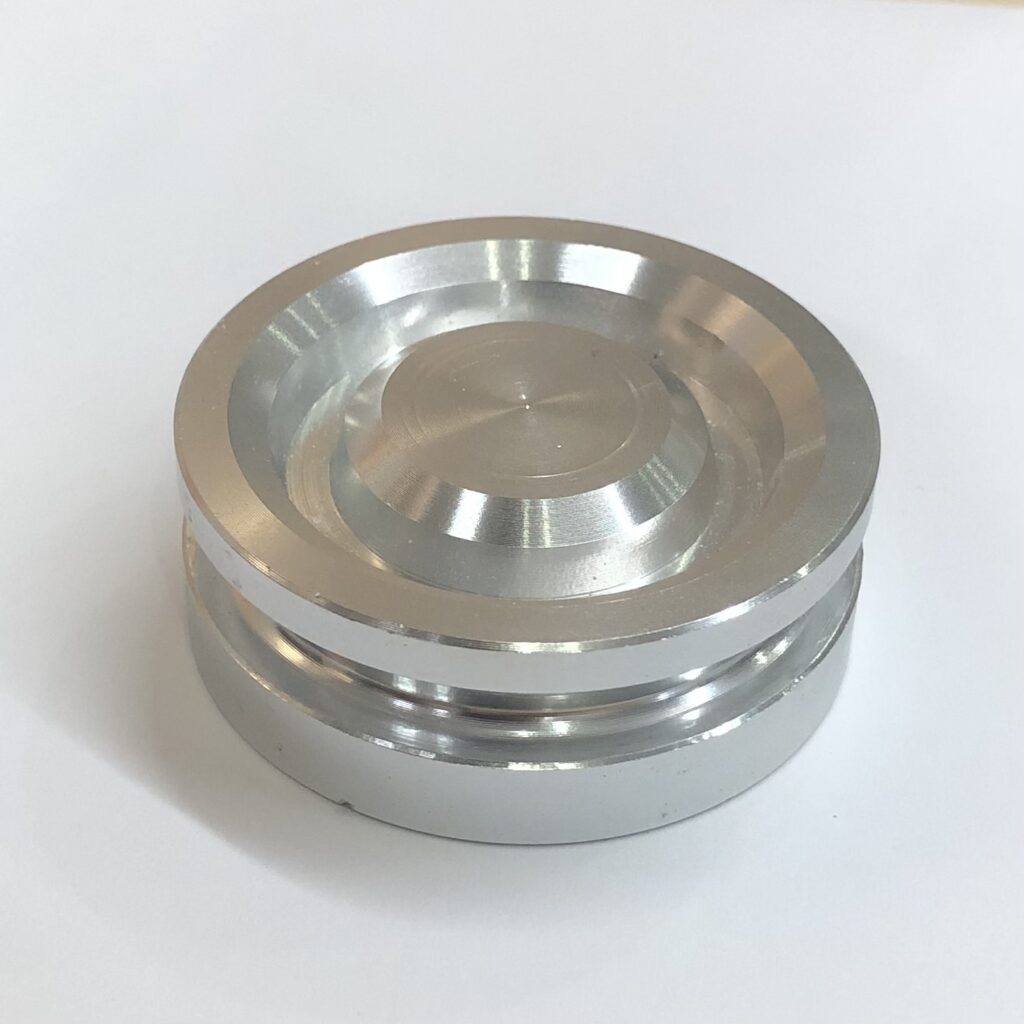
The floating piston is the key to the stable operation of monotube high-pressure shock absorbers.
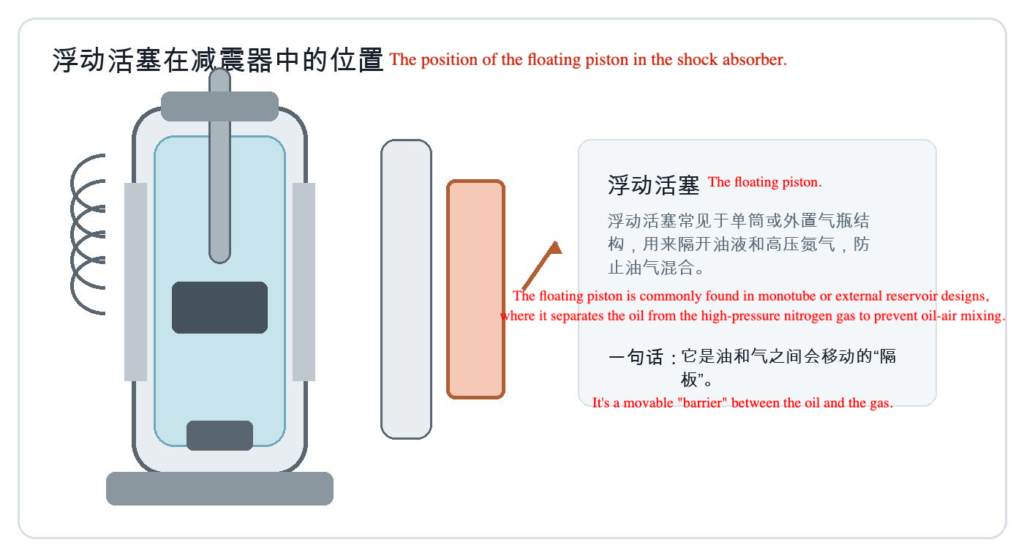
1. What It Is
The floating piston is not connected to the piston rod. Instead, it moves freely between the oil and the nitrogen gas. As the oil volume changes, the piston moves to compress or release the gas space.
Analogy for non-technical people:
Think of it like a sliding partition inside a thermos — with liquid on one side and gas on the other. They don’t mix, but they still transfer pressure to each other.
2. Common Materials
Material selection is usually not based solely on strength — it also takes into account wear resistance, corrosion resistance, temperature stability, friction characteristics, machining cost, and batch-to-batch consistency.
| Part / Material | Why It’s Used | Points to Watch |
| Aluminum alloy | Lightweight, good machinability, fast response. | Seal grooves and surface treatment must be reliable. |
| Steel | High strength, good pressure resistance. | Relatively heavy. |
| Engineering plastic / composite materials | Low friction, lightweight. | Temperature resistance and dimensional stability must be verified. |
| Rubber / PTFE seals | Isolate oil and gas, reduce leakage. | Wear may cause oil-gas mixing. |
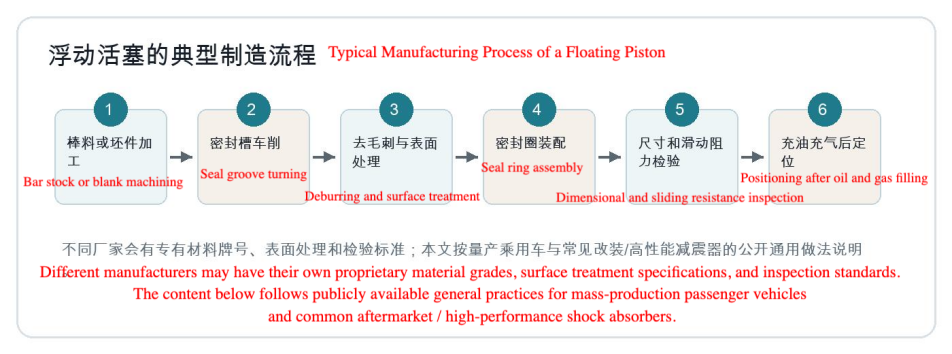
3. Manufacturing Processes
4. Functions in the Shock Absorber
Separates oil and nitrogen gas – prevents foaming and cavitation.
Compensates for piston rod volume displacement – maintains consistent internal volume as the rod moves in and out.
Maintains oil preload / pressurization – ensures stable and consistent damping response.
Increases oil capacity and heat dissipation – when used in a remote reservoir design, it allows for more oil volume and better cooling performance.
5. Differences Between Types
| Type | Characteristics | Functional Differences in Shock Absorbers | Suitable Applications |
| Built-in floating piston (monotube) | Located at the bottom of the main tube | Compact structure, direct response | Monotube shock absorbers |
| Remote reservoir floating piston | Located in a separate remote reservoir | Larger oil capacity, better heat dissipation | Off-road, racing |
| Air spring / bladder isolation type | Uses a bladder instead of a rigid piston | Lower friction, different construction | Certain motorcycle / specialty shock absorbers |
6. Quality Control & Common Failure Modes
| Critical Point | Why It Matters | Symptoms of Failure |
| Sealing reliability | Determines whether oil and gas stay separated | Damping fade, foaming / aeration |
| Sliding friction | Excessive friction slows response | Delayed / sluggish response |
| Positioning & gas preload | Affects effective stroke | Bottoming out or top out impact |
Observable Signs for Users or Maintenance Technicians
Shock absorber becomes soft and foamy – caused by oil gas mixing.
Abnormal stroke / travel behavior – caused by floating piston sticking or seizure.
Nitrogen enters the oil chamber – caused by seal damage.
7. Summary
The floating piston’s job is not to generate damping force, but to ensure that the hydraulic oil always operates at the correct pressure and remains free from contamination.
Note: Specific material grades, dimensions, tolerances, and process windows shall be based on the manufacturer’s drawings, technical specifications, and actual part inspection results. This document is intended for training, communication, and basic engineering understanding purposes only.