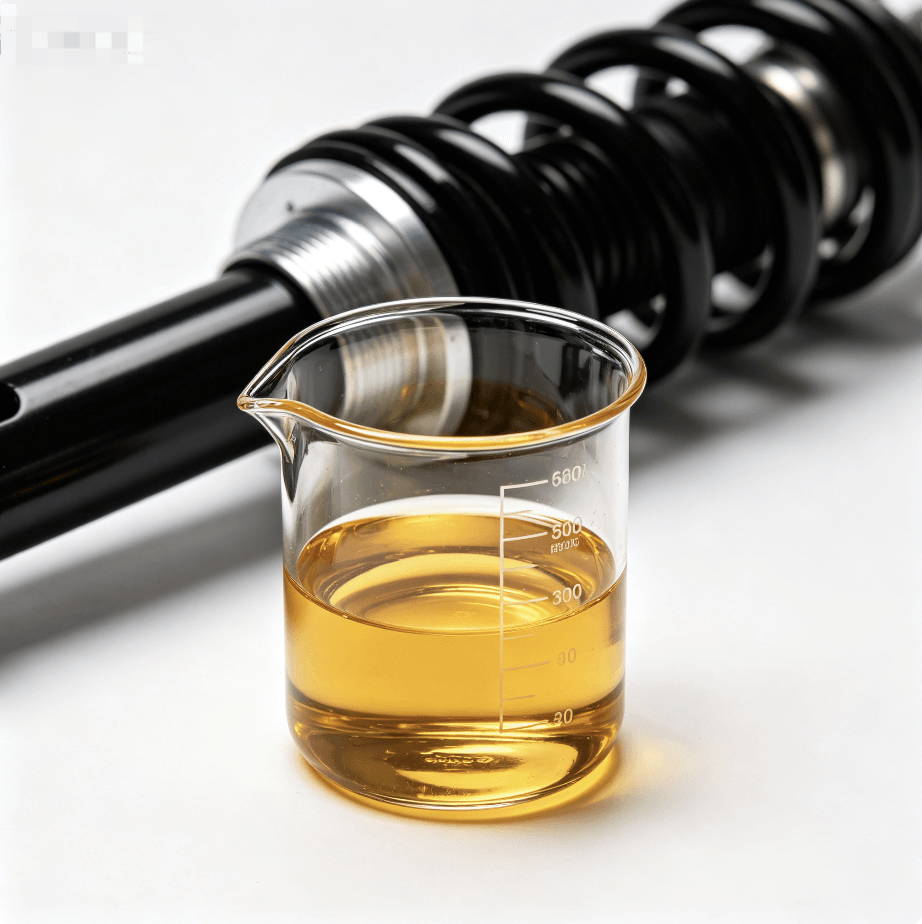
Shock absorber fluid is not just ordinary lubricating oil — it is an integral part of the damping system.
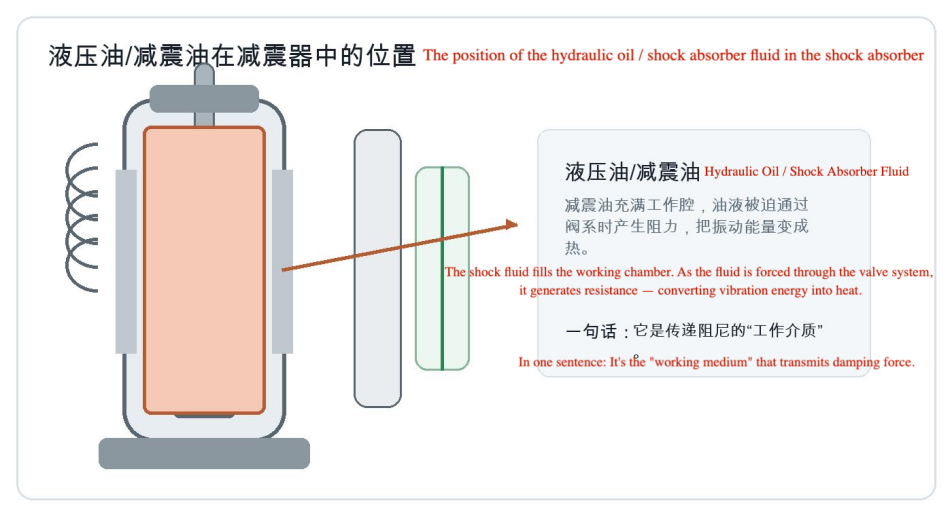
1. What It Is
Shock absorber fluid flows inside the shock, generating resistance as it passes through the piston valve and base valve. It also lubricates internal components, dissipates heat, protects against corrosion, and must be compatible with rubber seals.
Analogy for non-technical people:
Think of it like the fluid in hydraulic brakes — force is not transmitted through a rigid connection, but through liquid flow and pressure.
2. Base Oil Types / Materials
Material selection for shock absorber fluid is not based solely on viscosity or cost — it also takes into account thermal stability, anti wear properties, corrosion protection, foam resistance, seal compatibility, and production consistency.
| Component / Material | Why It’s Used | Points to Watch |
| Mineral base oil | Moderate cost, commonly used in mass production. | Viscosity temperature performance relies on additives. |
| Synthetic base oil | Better low temperature and high temperature stability. | Higher cost. |
| Anti foam / antioxidant / anti wear additives | Reduce bubbles, aging, and wear. | Must be compatible with seal materials. |
| Viscosity Index Improver | Reduces the effect of temperature on viscosity. | Must have good shear stability. |
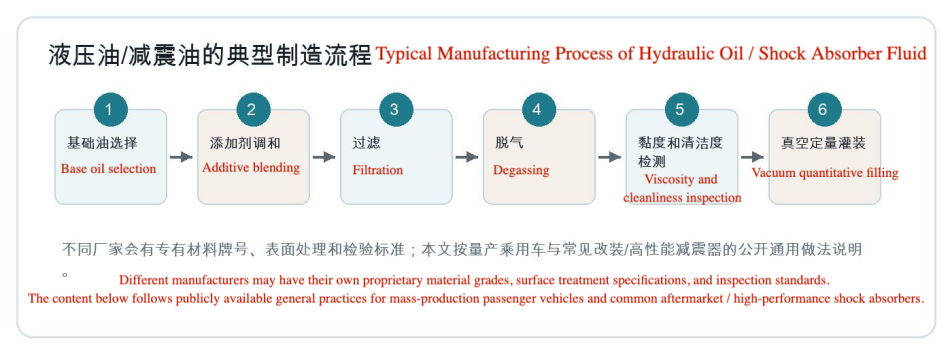
3. Manufacturing Process
4. Functions in the Shock Absorber
Generates damping force through controlled flow – as the fluid is forced through valves and orifices, it creates resistance that opposes motion.
Converts mechanical energy into heat and dissipates it – the fluid absorbs vibration energy and carries heat away through the shock body.
Lubricates internal contact surfaces – reduces friction and wear on the piston, rod guide, and seal interfaces.
Prevents internal corrosion – protects metal components from rust and chemical degradation.
5. Differences Between Types
| Type | Characteristics | Functional Differences in Shock Absorbers | Suitable Applications |
| Standard mineral shock oil | Low cost, sufficient for daily use | Basic damping medium | Mass production vehicles |
| Low temperature fluid | Small viscosity change at low temperatures | More stable response in cold conditions | Cold region vehicles |
| High temperature racing fluid | Strong resistance to heat fade | More stable under continuous heavy load | Racing, off road |
| Magneto rheological fluid | Contains magnetic particles | Changes flow characteristics when energized | MR (magnetorheological) shock absorbers |
6. Quality Control & Common Failure Modes
| Critical Point | Why It Matters | Symptoms of Failure |
| Viscosity | Directly affects damping force | Too stiff or too soft |
| Anti foam performance | Air bubbles compress | Damping fade, hollow / aeration noise |
| Cleanliness | Particles can stick in valves | Abnormal noise, premature wear |
Observable Signs for Users or Maintenance Technicians
Damping becomes weaker after prolonged high temperature operation – indicates fluid viscosity breakdown due to thermal degradation.
Foaming / aeration reduces support during continuous bumps – air bubbles compress and reduce hydraulic resistance.
Contaminant particles cause valve shims to stick or bind – debris interferes with valve movement, leading to erratic damping or stiction.
7. Summary
Shock absorber fluid is not just a lubricant — it is one of the key players that actually generates the damping force itself.
Note: Specific material grades, dimensions, tolerances, and process windows shall be based on the manufacturer’s drawings, technical specifications, and actual part inspection results. This document is intended for training, communication, and basic engineering understanding purposes only.