
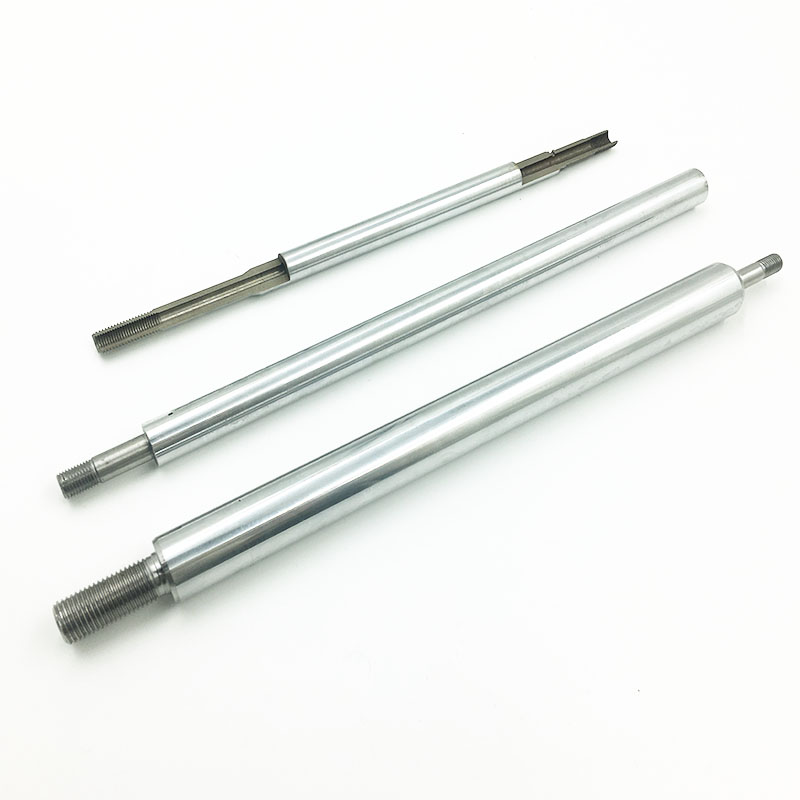
Shock absorber piston rods are subject to cyclic alternating tension, compression and bending impact loads. They are mostly manufactured from medium high strength steels such as 45# and 40Cr, and will subsequently undergo hard chrome plating. Heat treatment defines the fundamental mechanical properties of piston rods, while dehydrogenation is a critical safety procedure to prevent hydrogen embrittlement fracture. Skipping dehydrogenation will lead to potential risks of delayed brittle failure.
Why Heat Treatment (Quench and Tempering + High Frequency Surface Hardening) Matters
1. Quench and Tempering (Full volume bulk heat treatment: quenching plus high temperature tempering)
Quench and tempering delivers well balanced strength and toughness by producing tempered sorbite microstructure. The base material hardness is controlled within HB 229 285 to balance tensile strength, toughness and fatigue resistance.
Piston rods endure repeated alternating loads. Without proper quench and tempering treatment, insufficient strength will cause plastic bending deformation, whereas inadequate toughness may result in sudden fracture under impact.
This process relieves residual internal stress generated during forging and rough machining, minimizing bending distortion in subsequent machining and field service. It also creates a stable metallurgical foundation for later high frequency hardening and electroplating operations.
2. High frequency Induction Surface Hardening (For sliding working surface)
The outer diameter of piston rods keeps continuous friction with oil seals. High frequency surface hardening achieves high surface hardness of HRC 45 50 with a typical hardening depth of 0.7 1.1 mm. It greatly improves wear resistance, prevents premature wear and oil leakage, and extends the service life of shock absorbers.
Only the surface layer is hardened, while the core retains high toughness obtained from quench and tempering. This realizes the “hard surface, tough core” performance: wear resistant outer layer combined with a tough inner core that withstands impact and cyclic loads without overall brittle fracture.
⚠️ Risk note: Surface hardening introduces residual stress. Higher hardness steels are more susceptible to hydrogen embrittlement, so strict dehydrogenation must be performed after subsequent electroplating.
Why Dehydrogenation Baking (Hydrogen Relief) Is Indispensable
Source of hydrogen
During hard chrome plating of piston rods, large scale hydrogen evolution occurs on cathodes. Part of hydrogen atoms penetrate into the steel substrate. Pickling and electrolytic degreasing processes can also introduce hydrogen into the material.
Most electric energy consumed in chrome plating goes to hydrogen evolution, and only a small portion contributes to chromium deposition. Medium high strength steels are highly prone to hydrogen absorption.
Hazards of hydrogen embrittlement (Dangerous delayed fracture)
Hydrogen atoms accumulate at grain boundaries, inclusions and defects within the hardened layer, building up internal hydrogen pressure.
Typical feature: finished part inspection shows acceptable results, yet brittle fracture occurs unexpectedly after a period of vehicle operation under alternating loads far below the material yield strength, with almost no visible plastic deformation. This constitutes hidden safety hazards. Fracture surfaces show typical inter granular “rock candy” and claw mark morphology caused by hydrogen embrittlement.
✅ Standard dehydrogenation specification: Place parts into an oven within 3 hours after chrome plating, hold at 180 220 °C for 2 8 hours. Heat enables trapped hydrogen atoms inside steel to diffuse out and eliminates hydrogen embrittlement risks.
Consequences of skipping dehydrogenation
Under cyclic alternating loads from vehicle road vibration, hydrogen induced internal cracks propagate gradually. The piston rod may snap after weeks or months of service, leading to direct shock absorber failure and serious driving safety risks. In addition, plating layers tend to blister and peel off, and salt spray corrosion resistance deteriorates significantly.
Relationship between the Two Processes
Heat treatment (quench and tempering plus high frequency hardening) produces high strength piston rods. Nevertheless, higher material strength brings higher sensitivity to hydrogen embrittlement.
Heat treatment relieves residual stress from raw material processing, but cannot remove hydrogen absorbed in electroplating. Therefore independent dehydrogenation baking after plating is mandatory.
Even with fully qualified heat treatment, hydrogen embrittlement fracture can still happen if dehydrogenation is omitted. Conversely, dehydrogenation alone cannot guarantee adequate strength and wear performance without qualified heat treatment. The two procedures are equally essential and cannot replace one another.