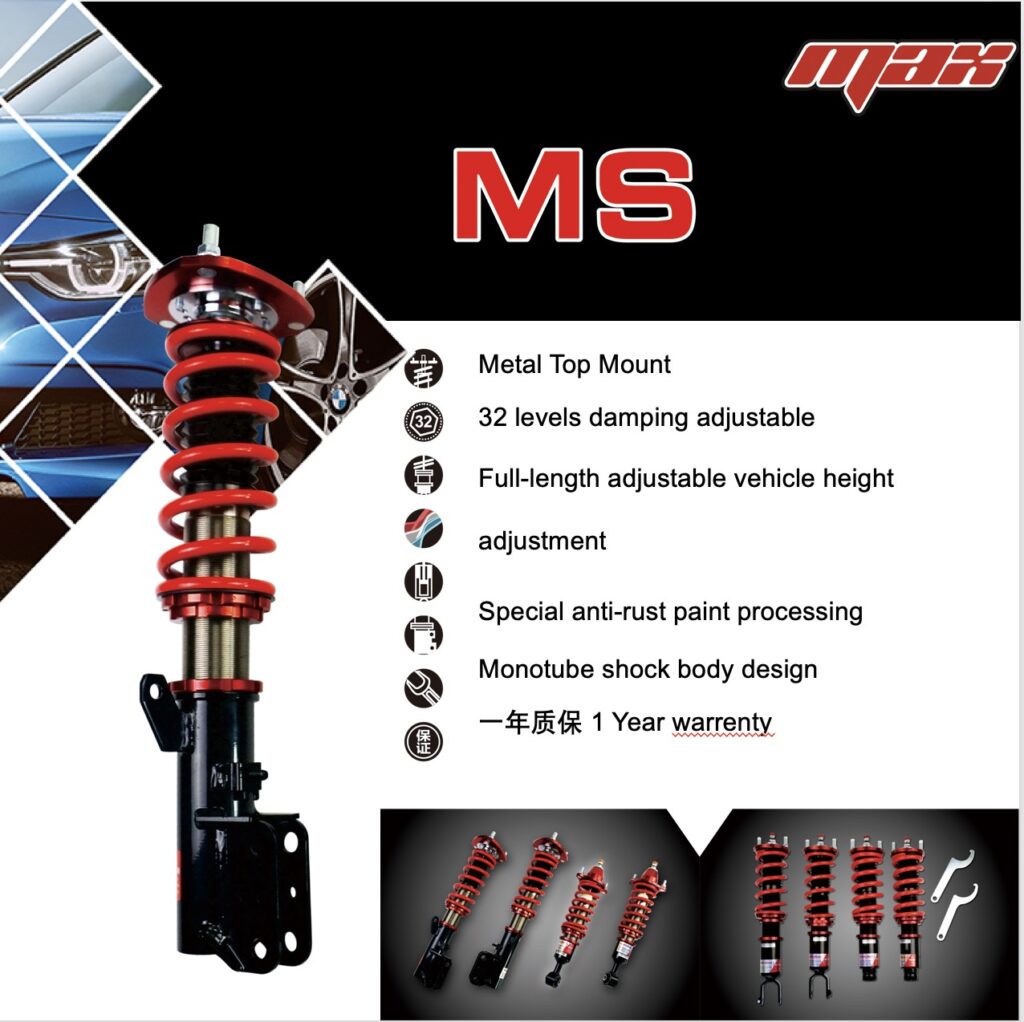
Development Background and Core Advantages
As the boundaries of automotive performance continue to expand and traditional hydraulic shock absorbers approach their physical limits, gas-pressurized monotube shock absorbers have gradually become the suspension component of choice for high-performance vehicles, luxury SUVs, and professional racing cars. This technology fundamentally transforms the operating characteristics of conventional oil-damping systems by introducing high-pressure nitrogen into the shock absorber. It achieves significant breakthroughs in response speed, heat fade resistance, damping linearity, and stability under extreme operating conditions.
Structural Mechanism of Floating Piston and Nitrogen Precharge
The core innovations of the gas-pressurized monotube shock absorber lie in its “oil-gas separation” and “high-pressure preload” mechanisms. In a traditional shock absorber during the compression stroke, as the piston rod enters the working cylinder, the internal volume decreases, requiring additional space to accommodate the displaced oil. A twin-tube design relies on an external reservoir chamber, whereas the monotube design employs a floating piston to divide the cylinder into two chambers: an upper chamber and a lower chamber. The upper chamber is filled with high-pressure nitrogen at 20–30 bar, while the lower chamber contains hydraulic oil. As the piston moves, changes in oil volume directly push the floating piston to compress or release the nitrogen. Nitrogen, acting as a near-ideal gas, offers high compressibility and rapid thermodynamic response, providing an exceptionally smooth and linear counterforce curve.
Suppression of Aeration and Damping Performance Stability
The introduction of high-pressure nitrogen addresses two chronic issues in hydraulic shock absorbers: cavitation and aeration. Under high-frequency, high-amplitude operating conditions, the pressure inside a traditional shock absorber can drop sharply, causing localized vaporization of the oil and the formation of tiny bubbles. When these bubbles enter the damping valve passages, they significantly reduce the effective flow area of the oil, leading to an instant drop in damping force — a phenomenon known as “heat fade.” In contrast, the gas monotube maintains a consistently positive pressure environment. The oil molecules are tightly surrounded by high-pressure nitrogen, which significantly raises their boiling point, fundamentally eliminating the possibility of vaporization. As a result, the gas monotube can maintain over 90% of its initial damping effectiveness under extreme conditions such as repeated heavy braking, track cornering, or off-road climbing.
Dynamic Response and Extreme Driving Performance
In terms of response speed, the high-pressure nitrogen preload gives the system an “instant-on” characteristic. Conventional shock absorbers have a slight delay (typically a few milliseconds) during initial activation as they must overcome static seal friction and oil inertia. In contrast, the preloaded environment of a gas monotube keeps the oil in a slightly pressurized state — as soon as the piston is loaded, damping force is established immediately. This millisecond-level difference in response can directly determine whether a vehicle becomes uncontrollable during limit cornering on a track or an emergency lane change on a wet road. High-performance vehicles such as the Porsche 911 GT3 and BMW M Power series come standard with gas monotube shock absorbers to ensure chassis communication and ultimate handling precision.
Diversified Structural Designs and Application Fields
Technological evolution has not stopped there. Modern gas-pressurized monotube shock absorbers have given rise to several advanced configurations. The upside-down monotube(inverted monotube) attaches the heavy working cylinder to the knuckle side while the piston rod connects to the vehicle body, significantly reducing unsprung mass and improving suspension responsiveness. The external reservoir monotube places the gas chamber outside the main cylinder, connected via a high-pressure hose. This design increases oil capacity, expands heat dissipation surface area, and allows for more flexible chassis packaging, making it widely used in rally cars and professional drift vehicles. The electronically controlled gas monotube (such as CDC or magnetorheological (MRC) dampers) utilizes piezoelectric valves or magnetorheological fluid technology to achieve real-time damping adjustments hundreds of times per second, seamlessly blending comfort and sportiness.
Operating Specifications and Fault Judgment
Installation and maintenance require special attention. Gas monotube shock absorbers have extremely high internal pressure. Never cut, drill, or heat the cylinder body — doing so could cause an explosion. When replacing the shock, you must use specialized tools to release the internal pressure and follow the specified torque values for tightening. In daily use, if you notice significant oil leakage on the outer wall of the shock, metallic knocking noises during driving, or obvious abnormalities in vehicle attitude, the shock should be replaced promptly to avoid collateral damage to the suspension control arms and steering tie rods.
Technical Summary and User Orientation
The gas monotube shock absorber represents the pinnacle of current hydraulic damping technology. Its sophisticated fluid dynamics design, demanding material requirements, and high manufacturing costs make it a component destined for drivers who pursue ultimate performance. For average users, a conventional twin-tube or low-pressure monotube is already more than sufficient. However, for enthusiasts who crave pushing beyond limits, desire precise road feel, and demand track-grade stability, the gas monotube is the ultimate answer for chassis upgrading. Understanding how it works and respecting its physical characteristics is the only way to safely and effectively harness this gift of performance delivered by high-pressure nitrogen.