1. What It Is
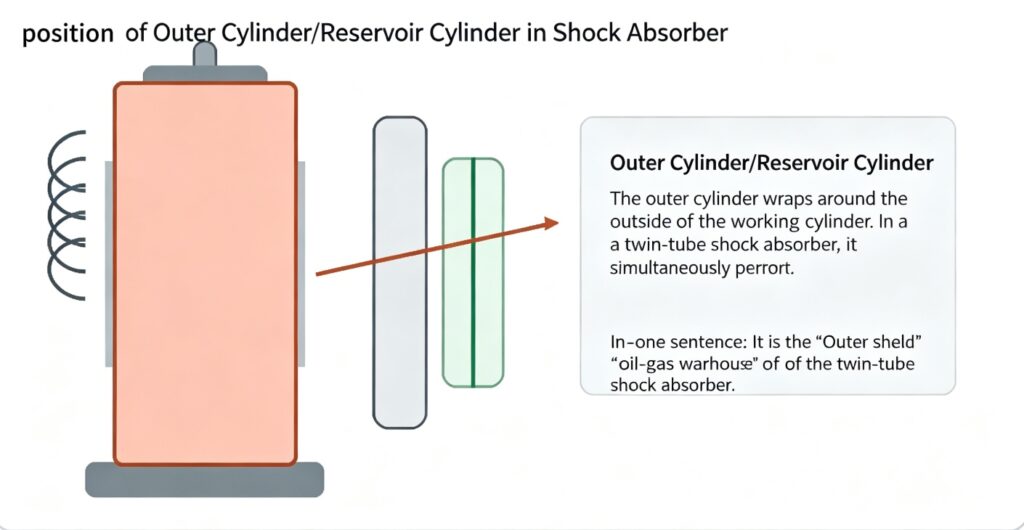
The outer cylinder is the outermost layer of a shock absorber, enclosing the inner working cylinder, oil reservoir, and gas space. Mounting brackets, spring seats, or rings are often welded to it.
Analogy for non-technical readers: It is like the outer shell of a thermos flask. It’s not just for appearance; it protects internal structures and provides mounting connection points.
2. Common Materials
Material selection depends not only on strength, but also a balanced combination of wear resistance, corrosion resistance, thermal stability, friction performance, processing cost and mass production consistency.
Material breakdown (itemized)
- Low carbon welded steel tube
- Reason for use: Good formability, low cost, convenient welding
- Key note: Reliable anti-corrosion coating is mandatory
- Thick-walled steel tube
- Reason for use: Applied to heavy-load or strut-type structures to boost bending resistance
- Key note: Increases overall component weight
- Aluminum alloy outer cylinder
- Reason for use: Lightweight, outstanding heat dissipation, widely adopted in high-end products
- Key note: Higher cost and stricter standards for surface treatment
3. Manufacturing Processes
- Tube cutting
- End swaging or flanging
- Welding of brackets and spring seats
- Leakage test & dimensional inspection
- Phosphating / electrophoretic coating / powder coating anti-corrosion treatment
- End sealing and finished product assembly
4. Functions in Shock Absorbers
- Protect the inner working cylinder and hydraulic oil
- Store compensating oil and gas in twin-tube shock absorber structures
- Provide mounting base for vehicle body, suspension and spring seats
- Assist heat dissipation and isolate external corrosion
5. Differences Between Various Outer Cylinder Types
Type breakdown (itemized)
- Standard twin-tube outer cylinder
- Features: Low cost, excellent ride comfort performance
- Functional difference in shock absorber: Responsible for oil storage and overall protection
- Applicable scenarios: Mass-produced passenger vehicles
- Strut-type outer cylinder
- Features: The outer cylinder bears suspension load together with other parts
- Functional difference in shock absorber: Higher requirements for structural strength and welding quality
- Applicable scenarios: McPherson strut assemblies
- Aluminum alloy outer cylinder
- Features: Lightweight and superior heat dissipation capacity
- Functional difference in shock absorber: Suitable for high-performance and rebuildable shock designs
- Applicable scenarios: Race cars, modified suspension kits
6. Quality Control & Common Failures
Quality control inspection items (itemized)
- Welding strength
- Importance: Brackets and spring seats rely entirely on welds for load bearing
- Failure manifestation: Cracked brackets, abnormal positioning of suspension parts
- Anti-corrosion coating
- Importance: The outer cylinder is constantly exposed to mud, water and salt spray environment
- Failure manifestation: Perforated rust, oil seepage
- End sealing performance
- Importance: Determines sealing reliability and assembly safety
- Failure manifestation: Oil leakage or loose end caps
Malfunctions observable by users and maintenance technicians
- Severe rust on outer cylinder will reduce structural strength
- Cracked spring seat welds cause abnormal noise or uneven vehicle ride height
- Outer cylinder deformation from collision may damage the internal working cylinder
7. One-Sentence Summary
The outer cylinder is more than just an outer shell; it undertakes protection, oil storage, installation and anti-corrosion functions all at once.
Disclaimer
Exact material grades, dimensions, tolerances and process windows shall comply with manufacturer drawings, technical specifications and physical part testing. This document is intended for internal training, cross-department communication and basic engineering study only.