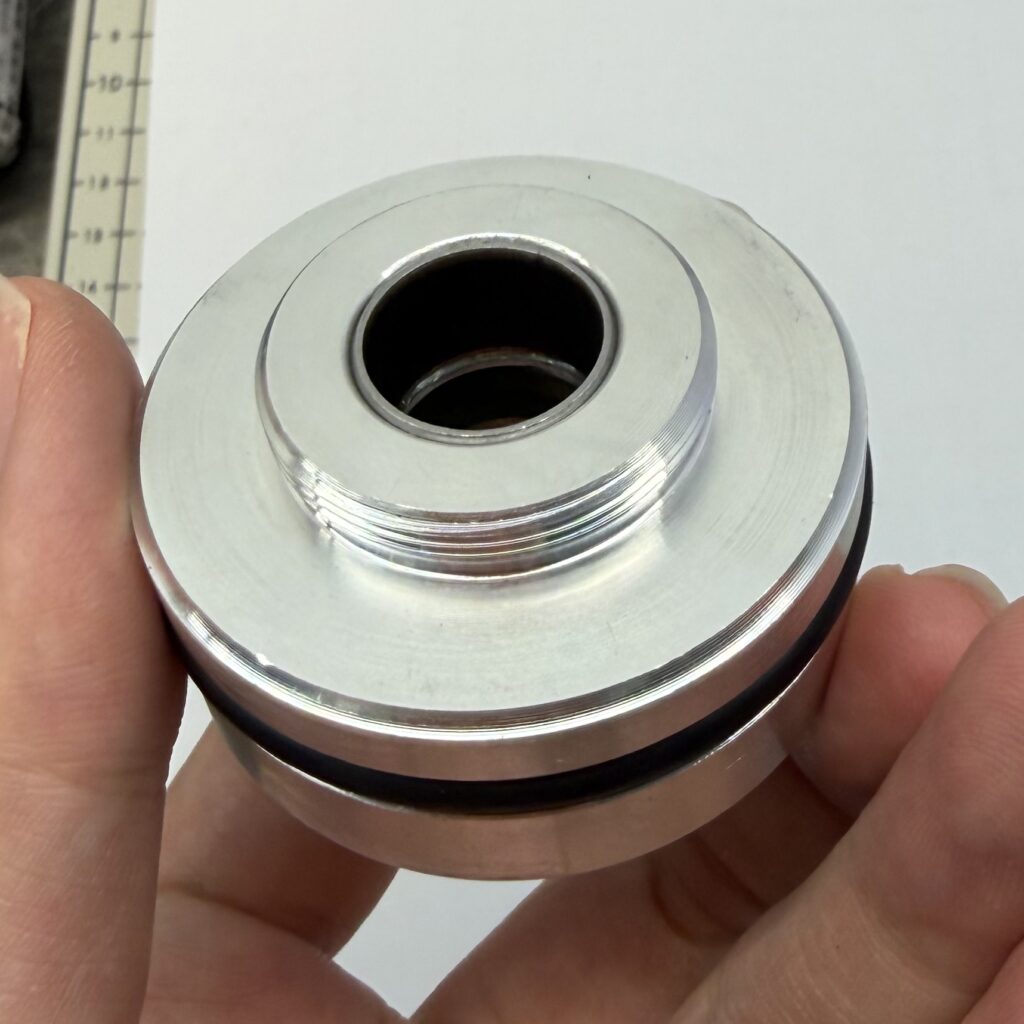
The rod guide determines whether the piston rod can move in and out of the shock absorber smoothly and with low friction.
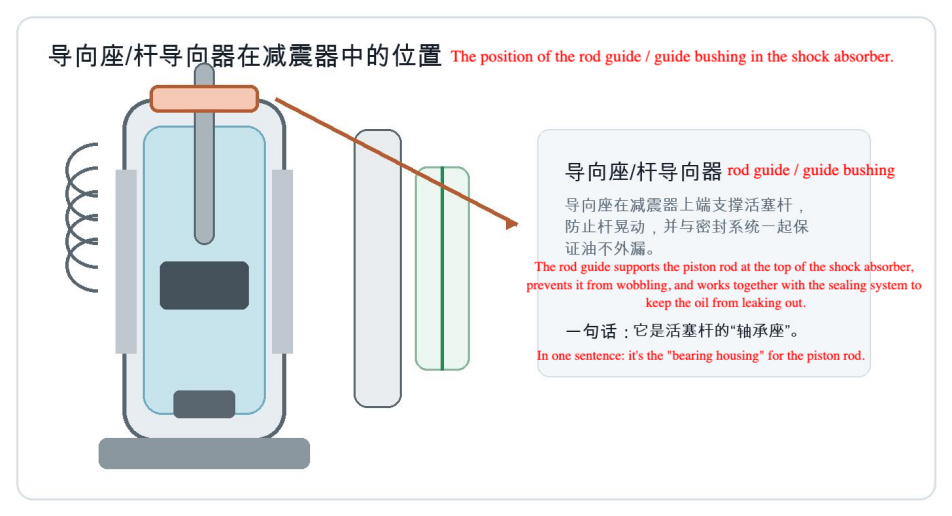
1. What It Is
The rod guide is located at the opening of the shock absorber. Its inner bore supports the piston rod, while its outer surface fits into the shock tube. It is often combined with the oil seal and dust wiper to form a complete seal head assembly.
Analogy for non-technical people:
Think of it like the bushing in a door hinge — it keeps the door moving along the right path, without wobbling or sticking.
2. Common Materials
Material selection is usually not based solely on strength — it also takes into account wear resistance, corrosion resistance, temperature stability, friction characteristics, machining cost, and batch-to-batch consistency.
| Part / Material | Why It’s Used | Points to Watch |
| Sintered iron | Good self lubrication and dimensional stability, suitable for mass production. | Porosity and strength must be controlled. |
| Aluminum alloy | Lightweight, easy to machine, good heat dissipation. | Wear prone areas require a bushing insert or surface treatment. |
| Steel | High strength, suitable for heavy loads. | Friction pair design must be properly engineered. |
| PTFE / bronze composite bushing | Reduces friction and protects the piston rod. | Wear may cause the rod to wobble. |
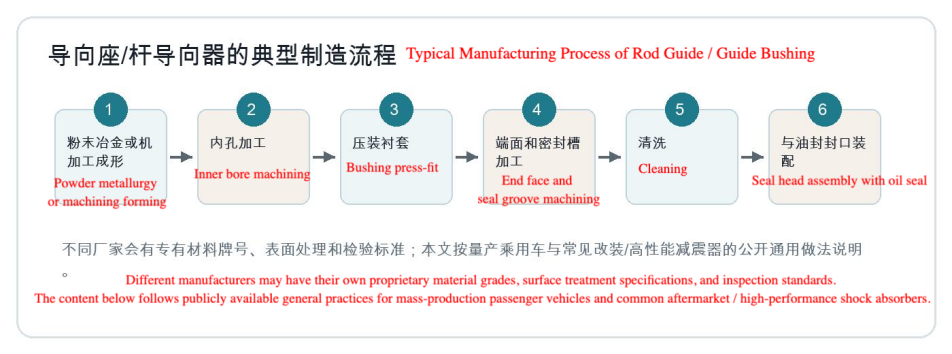
3. Manufacturing Process
4. Functions in the Shock Absorber
- Supports the piston rod and maintains coaxial alignment.
- Absorbs lateral loads to protect the oil seal.
- Reduces friction between the rod and the shock tube.
- Serves as part of the shock absorber seal head assembly.
5. Differences Between Types
| Type | Characteristics | Functional Differences in Shock Absorbers | Suitable Applications |
| Sintered guide bushing | Suitable for high volume production, cost effective | Commonly used in passenger cars | OEM / factory shock absorbers |
| Guide bushing with composite liner | Lower friction, better wear resistance | Improves response and service life | High performance / aftermarket |
| Replaceable guide bushing | Serviceable / rebuildable design | Facilitates easy rebuild and maintenance | Racing, off road |
6. Quality Control & Common Failure Modes
| Critical Point | Why It Matters | Symptoms of Failure |
| Inner bore concentricity | Determines whether the rod moves straight or with deviation | Oil leakage, uneven / eccentric wear |
| Bushing press-fit | Affects friction and clearance stability | Noise (knocking), looseness, or seizure |
| Material porosity and strength | Must withstand long term vibration and cyclic loads | Cracking, fracture, or excessive wear |
Observable Signs for Users or Maintenance Technicians
- Piston rod wobbling – oil seal starts leaking prematurely.
- Knocking noise – caused by guide bushing wear.
- Sticking / seizure – caused by inner bore corrosion or deformation.
7. Summary
The rod guide is not a seal, but it determines whether the seal can function properly over the long term.
Note: Specific material grades, dimensions, tolerances, and process windows shall be based on the manufacturer’s drawings, technical specifications, and actual part inspection results. This document is intended for training, communication, and basic engineering understanding purposes only.