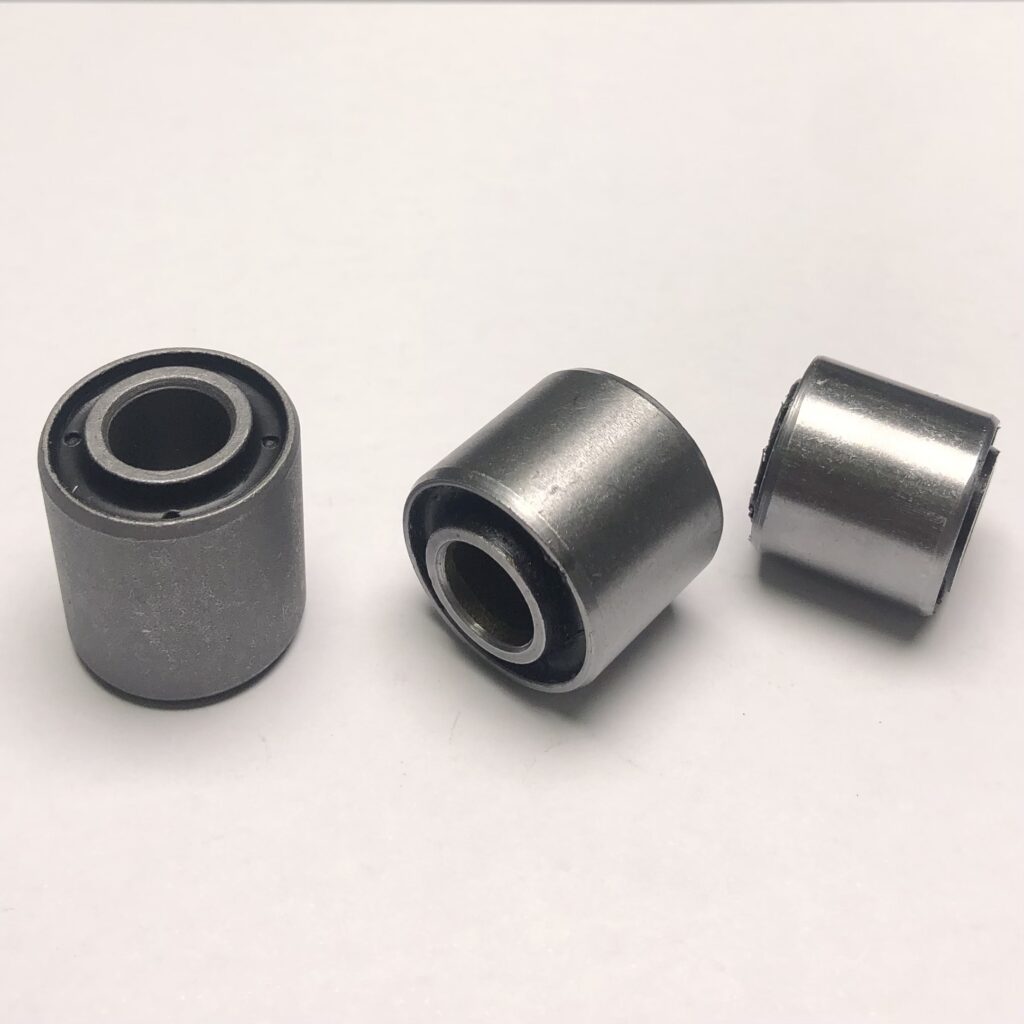
The rubber bushing is a typical small component that affects noise and ride comfort.
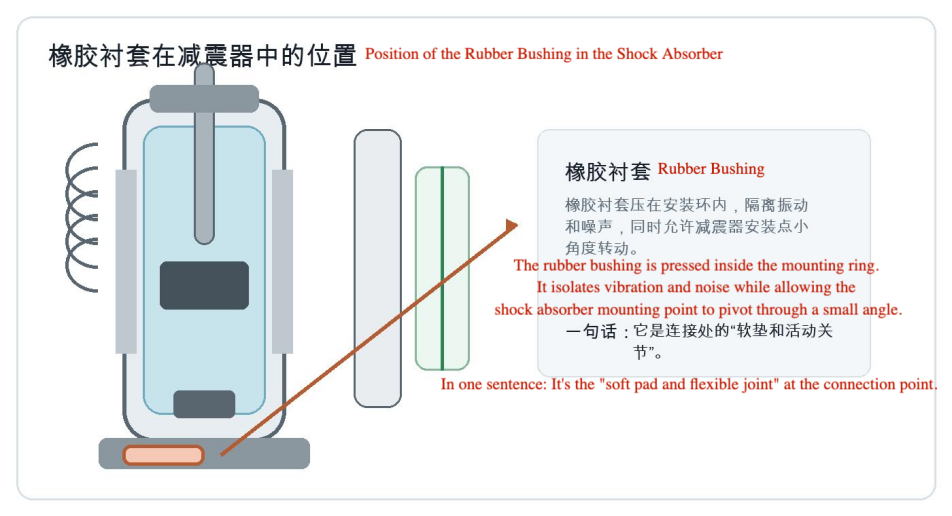
1. What It Is
The bushing consists of rubber and a metal sleeve, installed in the shock absorber mounting eye or bracket. It’s not a matter of “the harder, the better” — it needs to strike a balance between support and vibration isolation.
Analogy for non-technical people:
Think of it like the rubber layer on the sole of a shoe — it has to bear weight, but also cushion the impact between your foot and the ground.
2. Common Materials
Material selection is usually not based solely on strength — it also takes into account wear resistance, corrosion resistance, temperature stability, friction characteristics, machining cost, and batch-to-batch consistency.
| Component / Material | Why It’s Used | Points to Watch |
| Natural rubber (NR) | Good elasticity and fatigue performance. | Oil and ozone resistance must be controlled through formulation. |
| SBR / EPDM | Aging resistance or environmental resistance can be optimized. | Dynamic performance must be properly matched. |
| PU (Polyurethane) | High hardness, good wear resistance. | May generate more noise and vibration. |
| Steel inner / outer sleeve | Provides press-fit and bolt support. | Corrosion protection and bonding quality are critical. |
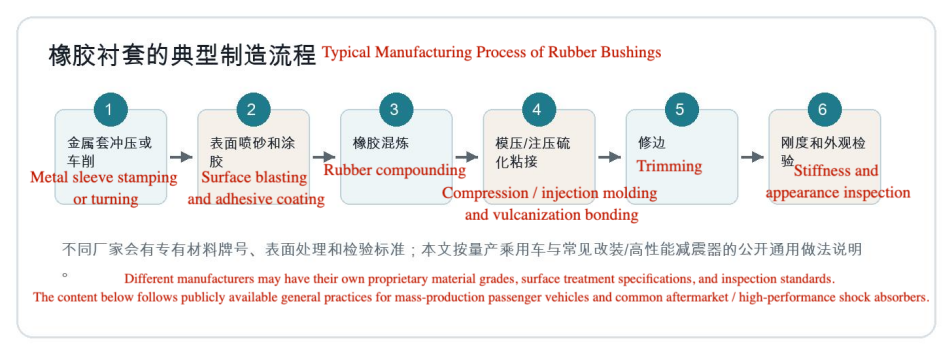
3. Manufacturing Process
4. Functions in the Shock Absorber
Isolates road vibration and noise
Allows small-angle pivoting at the mounting point , reduces lateral stress on the shock absorber.
Protects the piston rod and rod guide from excessive offset loads
Improves overall vehicle NVH comfort
5. Differences Between Types
| Type | Characteristics | Functional Differences in Shock Absorbers | Suitable Applications |
| Standard rubber bushing | Comfortable, quiet | Good vibration isolation | Family cars |
| Hydraulic bushing | Contains internal fluid chamber | Better vibration isolation at specific frequencies | High-comfort vehicles |
| PU bushing | Stiff, direct response | Less deflection, improved road feel | Tuning / performance |
| Spherical joint (pillow ball) | Almost no rubber deflection | Precise positioning but more noise | Racing |
6. Quality Control & Common Failure Modes
| Critical Point | Why It Matters | Symptoms of Failure |
| Rubber hardness | Affects support and vibration isolation | Too hard — noisy; too soft — excessive movement |
| Rubber-to-metal bonding | Prevents debonding | Abnormal noise, looseness |
| Aging resistance | Long-term exposure to environment | Cracking, collapse |
Observable Signs for Users or Maintenance Technicians
- Clunking noise when going over bumps
- Cracks or debonding on the bushing
- A loose feeling at the rear or front of the vehicle
7. Summary
The value of a rubber bushing lies in turning a rigid connection into one that is quiet, flexible, and tolerant of angular movement.
Note: Specific material grades, dimensions, tolerances, and process windows shall be based on the manufacturer’s drawings, technical specifications, and actual part inspection results. This document is intended for training, communication, and basic engineering understanding purposes only.