
Abstract
From the perspective of system matching, this paper analyzes the coordination relationship among pistons, base valves and guides of hydraulic shock absorbers, summarizes common failure modes of key components, and prospects the future technical development trends.
Core Knowledge Points
- The overall performance of shock absorbers relies on in-depth system matching of pistons, base valves and guides.
- Parameter changes of a single component will cause chain effects. Global tolerance chain management and multi-physics field simulation are required.
- The piston determines damping stiffness, the base valve decides operational compliance, and the guide sets the service life and the lower limit of NVH performance.
- The fully automatic oil filling and rolling process controls the clearance within 0.02 mm to eliminate burrs and residual stress.
- 60% of early failures are caused by guide seal damage and valve plate fatigue, which mainly result from improper compensation of base valves and poor internal cleanliness.
- Future development directions include magnetorheological technology, lightweight materials, intelligent sensors and closed-loop iteration based on digital twin technology.
Detailed Content
The performance of automotive hydraulic shock absorbers is not simply a combination of individual parts. It requires in-depth system matching of core components including piston valve assemblies, base valves, guides, cylinders and piston rods in terms of fluid mechanics, structural mechanics and tribology.
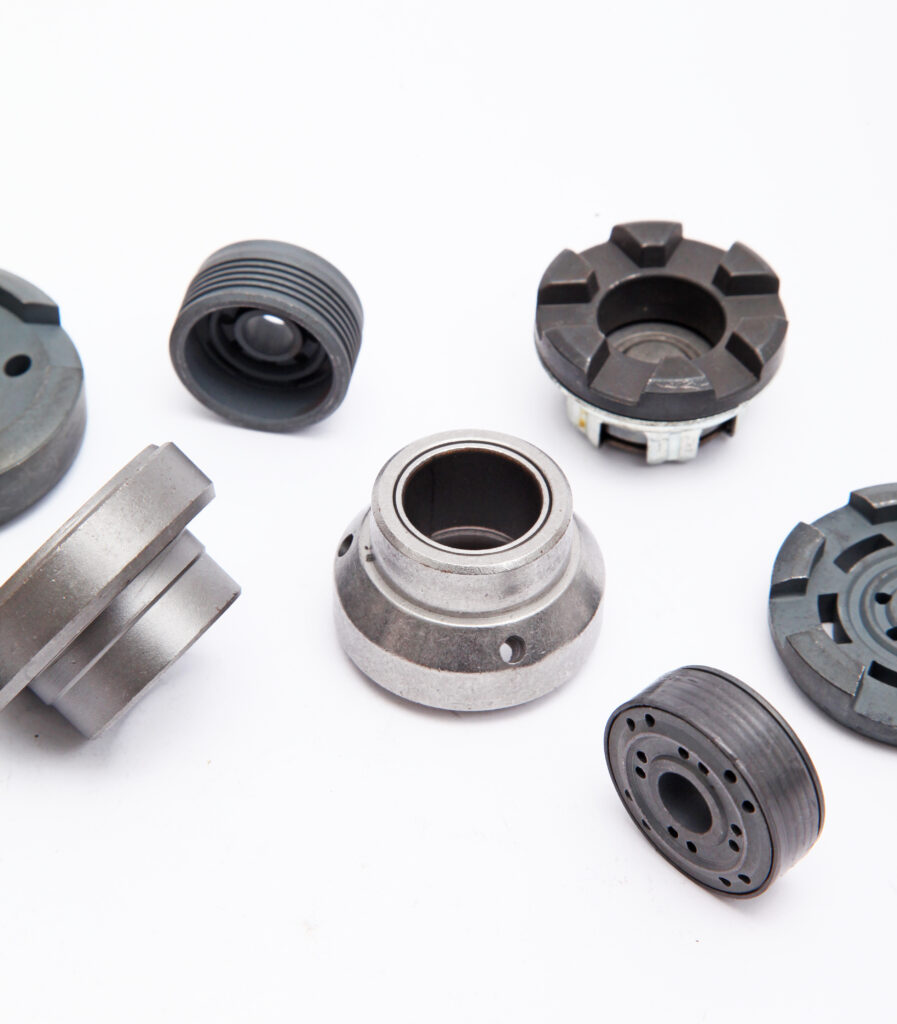
System Matching Logic
All core components work interactively during operation. Any adjustment to the structure, size or material of one part will affect the operating state of the whole shock absorber. Therefore, it is necessary to adopt overall tolerance chain design and multi-physics field simulation to ensure coordinated performance of all parts.
Division of Work for Three Core Components
Each component undertakes distinct core functions. The piston valve system controls the overall damping stiffness. The base valve regulates the smoothness and compliance during compression strokes. The guide directly influences the product service life and defines the basic level of vehicle NVH performance.
Manufacturing Process Requirements
Advanced fully automatic oil filling and rolling technology is adopted in production. It keeps the assembly clearance strictly within 0.02 mm, effectively removing surface burrs and eliminating internal residual stress, so as to guarantee stable long-term operation.
Failure Mode Analysis
Statistically, 60% of early failures of shock absorbers occur on guide seals and valve plates due to fatigue damage. The fundamental causes are unreasonable compensation performance of base valves and insufficient internal cleanliness of the shock absorber.
Future Technical Trends
The industry will continuously explore and apply new technologies. Magnetorheological damping, lightweight structural materials, built-in intelligent sensors and digital twin systems will be widely used to realize closed-loop design, testing and performance iteration.
Summary
Excellent shock absorber performance is based on scientific system matching of core components rather than separate part design. Strict process control and failure risk assessment are essential to improve product quality. With the progress of automotive technology, shock absorbers will develop towards intellectualization, light weight and higher comprehensive reliability.