Abstract
This paper focuses on the core control component of automotive hydraulic shock absorbers—the shock absorber piston. It systematically analyzes its core functions, structural composition, and types of oil passage designs, compares the technical characteristics and application scenarios of fixed-orifice and adjustable pistons, elaborates on the nonlinear damping control logic of two-stage valve systems and overflow channels, and looks forward to the technical development trend of active electro-hydraulic variable-section pistons. This provides theoretical support and practical references for the performance optimization and product development of shock absorbers.
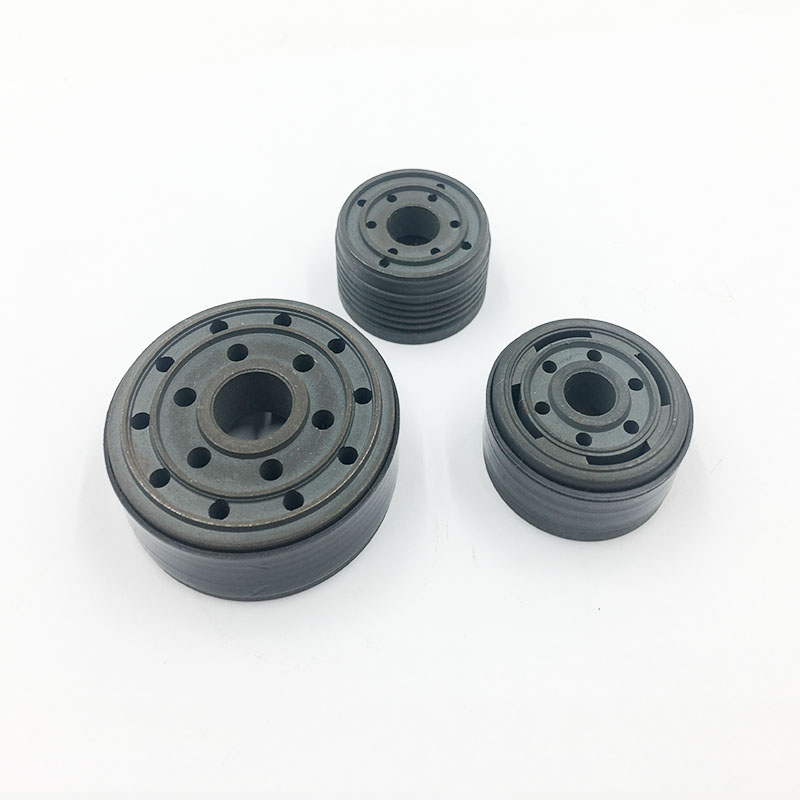
Structure Diagram

Core Knowledge Points
- The core function of the piston is to generate damping force by controlling oil throttling, so as to dissipate vibration energy and stabilize the vehicle’s motion posture.
- The main structure includes the piston body, rebound/compression valve plates, orifices, and limiting structures. Each component works together to achieve damping characteristic switching under different strokes.
- Oil passage designs are divided into uniformly distributed round holes, radial slots, and spiral grooves, which have significant differences in force distribution, oil flow rate control, and processing technology.
- Fixed-orifice pistons have low cost and high reliability but non-adjustable damping characteristics; adjustable pistons are flexible but have complex sealing structures and high costs.
- Two-stage valve systems and overflow channels realize nonlinear damping and bottoming protection through segmented throttling design.
- The future development trend of shock absorber pistons is towards active electro-hydraulic variable-section pistons, which adjust the throttling area in real time through electronic control to achieve optimal damping control under all working conditions.
Detailed Content
The piston of an automotive hydraulic shock absorber is the core working component of the entire damping system. Its main function is to reciprocate in the working cylinder filled with damping oil under the drive of the piston rod, and generate the required damping force by controlling the throttling resistance of oil flowing through the piston valve system, thereby suppressing the repeated bouncing of the spring, attenuating the vibration transmitted from the road surface, and ensuring the vehicle’s driving stability and ride comfort.

1. Structural Composition
The structural design of the shock absorber piston directly determines the damping characteristics. The core components include the following categories:
- Piston Body: Usually made of powder metallurgy or high-strength steel. It is the base component of the piston. The outer ring cooperates with the inner wall of the cylinder for guidance, and the central hole is connected to the piston rod, serving as a key carrier for damping force transmission.
- Valve System Components: Including rebound valve plates, compression valve plates, and matching springs. The valve plates are installed on both sides of the piston in a stacked manner. Under different strokes, oil pressure pushes the valve plates to deform, changing the opening of the throttling passage and realizing differentiated control of damping characteristics during rebound and compression strokes.
- Orifices/Oil Passages: Oil flow passages distributed on the piston body, which are the paths for damping oil to flow between the upper and lower chambers. The number, diameter, and shape directly affect the throttling resistance, which is the core link of damping force control.
- Limiting Structures: Including valve plate limit seats and circlips, which are used to limit the maximum opening stroke of the valve plates, avoiding fatigue damage caused by excessive deformation of the valve plates, and preventing oil flow out of control under high-speed conditions.
2. Types of Oil Passage Designs
Different oil passage designs adapt to different damping requirements. Common types and their characteristics are as follows:
- Uniformly Distributed Round Hole Oil Passage: Multiple circular throttling holes are evenly distributed on the piston body. It is simple to process and low in cost, with stable oil flow resistance, suitable for ordinary civilian vehicles. However, the oil flow velocity distribution is uneven, turbulence is prone to occur under high-speed conditions, and the linearity of damping characteristics is average.
- Radial Slot Oil Passage: Radial slot passages are opened on the piston body. The oil flow is restricted by the slots to generate throttling resistance. The damping force can be accurately controlled by adjusting the width and length of the slots. The force distribution is uniform, and the high-speed turbulence phenomenon is weak, which is widely used in sports shock absorbers.
- Spiral Groove Oil Passage: Spiral oil grooves are processed on the surface of the piston body. The oil flows along the spiral grooves to generate additional rotational resistance, which can achieve a smoother damping curve and improve the stability of oil flow. It is mostly used in shock absorbers of high-end vehicles pursuing comfort.
3. Advantages and Disadvantages of Fixed-Orifice Pistons
The diameter and number of throttling holes of fixed-orifice pistons are fixed during manufacturing, and the damping characteristics are not adjustable. It is the most widely used type of piston at present:
- Advantages: Simple structure, no complex valve plate adjustment mechanism, low manufacturing cost, high reliability, easy maintenance, suitable for mass production, and can meet the basic shock absorption needs of ordinary family cars.
- Disadvantages: The damping characteristics are fixed, and it cannot adapt to the shock absorption needs under different road conditions and different loads. For example, insufficient damping under heavy load conditions is easy to cause vehicle body shaking, and the damping is too soft to provide sufficient support during aggressive driving, resulting in poor performance flexibility.
4. Advantages and Disadvantages of Adjustable Pistons

Adjustable pistons change the opening of throttling holes or the preload of valve plates through external adjustment mechanisms to realize multi-stage adjustment of damping force. They are commonly used in modified shock absorbers and high-end vehicle shock absorbers:
- Advantages: Adjustable damping characteristics, which can switch different damping modes according to driving scenarios (such as daily commuting, aggressive driving, off-road driving), balancing comfort and handling, with strong adaptability, and can meet personalized modification and complex working condition needs.
- Disadvantages: Complex structure, requiring supporting adjustment knobs, adjusting rods, and sealing mechanisms, high manufacturing cost, and great difficulty in multi-channel sealing. There is a risk of oil leakage after long-term use, which requires extremely high processing accuracy and assembly technology.
5. Design Principles of Two-Stage Valve Systems
To solve the problem that single-stage valve systems cannot balance low-speed and high-speed working conditions, two-stage valve systems and overflow channel designs are widely used:
- Working Logic of Two-Stage Valve Systems: When driving at low speeds, the oil flow rate is slow and the pressure is low, only the first-stage valve plate is opened, the throttling resistance is small, and the damping force is soft, ensuring ride comfort; when driving at high speeds or encountering large impacts, the oil flow rate is fast and the pressure rises, pushing the second-stage valve plate to open, the throttling resistance increases sharply, and the damping force rises rapidly, providing sufficient support to suppress violent bouncing of the vehicle body.
- Function of Overflow Channels: When the shock absorber compression stroke approaches the limit, the oil flow rate is too large to be discharged in time through the throttling holes, the overflow channel opens to quickly release the oil pressure, avoiding direct impact of the piston on the bottom of the cylinder, preventing damage to the shock absorber, and realizing bottoming protection. This segmented throttling design allows the shock absorber to present nonlinear damping characteristics under low-speed, medium-speed, and high-speed conditions, perfectly balancing comfort and handling.
6. Summary and Outlook
The structure and valve system design of the shock absorber piston are the core factors determining the performance of the shock absorber. At present, fixed-orifice pistons still occupy the mainstream market due to their high cost performance, adjustable pistons continue to expand in the modification and high-end vehicle fields, and two-stage valve systems and overflow channel designs have become key technologies to improve the comprehensive performance of shock absorbers.
With the development of automotive electrification and intelligence, active electro-hydraulic variable-section pistons have become an important development direction in the future. Such pistons adjust the opening of throttling holes in real time through electronically controlled solenoid valves, combined with road conditions and vehicle posture data collected by vehicle sensors, to realize millisecond-level dynamic adjustment of damping force, truly achieving “on-demand shock absorption”, greatly improving driving stability and ride comfort under different working conditions, and providing key support for the implementation of intelligent chassis technology.